
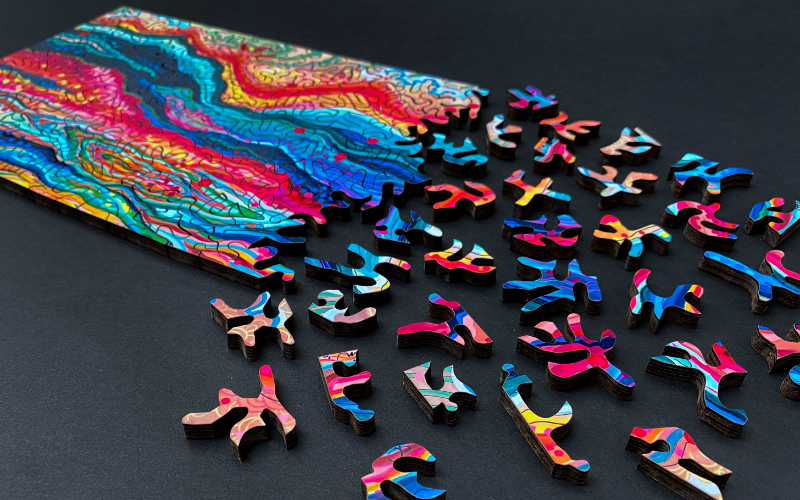
Free Jigsaw Puzzle becomes easier to enjoy once the rules are treated as information rather than obstacles. The strongest beginner setup is not the one with the most piles; it is the one that makes the next useful piece easy to see. The goal is not to memorize every advanced trick. It is to understand what a legal move reveals, what it closes, and when a tempting shortcut creates a harder board. A few plain habits can make the next session feel more readable without taking away the discovery.
Free Jigsaw Puzzle in practice
The basic rule is simple: prove the fit
A jigsaw piece is correct only when shape and image agree. Matching one tab to one blank is not enough if the color, line, or texture breaks at the join. This sounds obvious, but false fits are the main reason a difficult puzzle becomes harder than it needs to be. A piece can sit neatly in a position and still belong somewhere else.
Start with the strongest evidence. Corners and straight edges define the frame. A face, window, sign, branch, or bright color patch creates a landmark. Repeated grass, water, or sky should usually wait until the surrounding structure gives it a better address.
Sort for decisions, not for decoration
The best sorting system is the one that makes the next useful move visible. Keep edge pieces separate, then create small groups for strong colors, distinctive textures, and obvious image objects. Do not make so many piles that every piece becomes hard to reach. A clean tray is helpful only when it leads to a real connection.
On an online board, the same principle applies through loose clusters. Spread similar pieces enough to compare them, but leave room for the section that is actually growing. The puzzle should look more organized after ten minutes, not merely more crowded.
Keep false fits out of the final picture
Play a jigsaw puzzle on the main site and search this site for more jigsaw strategy. Britannica’s overview offers useful context, and the World Jigsaw Puzzle Federation shows how much deliberate observation can sit behind a calm-looking solve.
A clean checklist for the next game
Start by finding the visual change that is easiest to trust. A straight edge, a hard line, a face, a window, or a bright color block is more useful than a large pile of similar pieces. Build a small island around that signal and let the image expand outward. The island does not need to be large. It needs to be reliable enough that nearby pieces become easier to judge.
Keep uncertain pieces outside the main structure. If a piece almost fits, leave it nearby with its group instead of placing it into the picture. That preserves the truth of the growing image. A false fit feels like progress for a few seconds, then costs much more time when several pieces have been built on top of it.
Change the sorting system when the image changes. A landscape may need color and horizon groups. A building may reward line direction and windows. An animal portrait may begin with eyes, fur, and strong outlines. There is no universal pile arrangement because the picture itself is the puzzle’s instruction manual.
For a short practice session, open a new jigsaw on Easy Daily Puzzle and find more jigsaw-solving ideas on this site. Set a small goal such as one landmark or one border section. Stopping after a trustworthy improvement is better than continuing until the table becomes a wall of confusing pieces.
The small detail worth remembering
The picture should become clearer as the session continues. If the table is getting more crowded but the image is not getting more trustworthy, change the sort or remove a false fit. Organization is not the goal by itself; it is a way to make visual evidence easier to compare.
A finished section does not need to be large to be useful. One reliable island can tell you which colors, lines, and shapes belong nearby. Let that information guide the next group instead of trying to solve the whole image at once.
The most efficient players are not afraid to leave a difficult texture alone. A clear landmark will often solve more of the surrounding image once it has room to grow.
For a little more context, read Britannica’s jigsaw puzzle overview and World Jigsaw Puzzle Federation. These references are useful for checking the basic history or rules without turning a daily game post into a long reference list.